
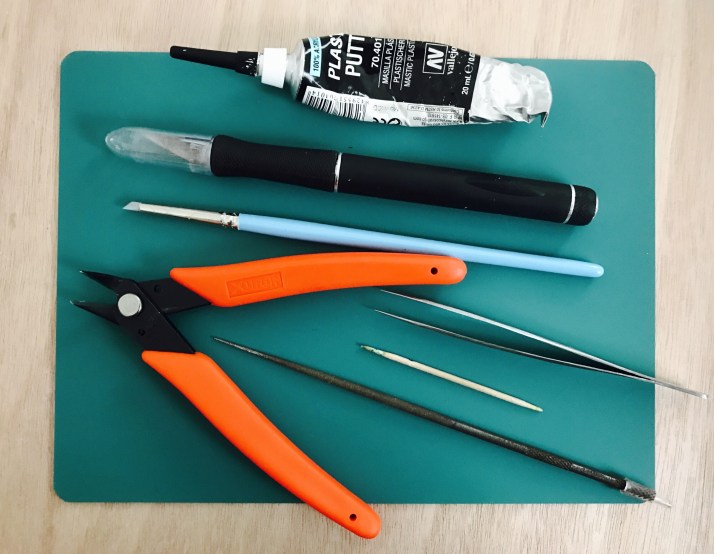
A collection of basic modeling tools, toothpick well-used.
Tools Part 2: A Trifling List
(Adult supervision as appropriate. How many pointy objects can you find?)
1. A good hobby knife such as X-Acto for trimming plastic. Technically this is the pointy number 11 blade. Safety precautions per manufacturer should be followed.
2. Consider a good stationary magnifying source with good lighting. I live with these for modding and painting. Godspeed to those eagle-eyes of you out there. Stories perhaps later…
3. Get some plastic modeling putty. There are many. I like Vallejo products, myself, but any will do. Testors and others make this stuff available in wide-mouth bottle form. If you want to work with lots of vehicles or corners of architecture, get the Vallejo tube with the needle applicator, not the bottle, as smaller amounts can be distributed. I work with a small wooden or paper palette for this, usually with an amount at the tip of a TOOTHPICK. This should give a suggestion as to the small size of application, but a small glop of any of these will suffice. Larger glops as used in terrain can be manipulated using small silicon-tipped clay tools. Theses are fantastic.
4. Speaking of toothpicks, these are a must. Besides manipulating modeling putty, you can stir things, apply glue, even gingerly rub off mis-applied paint or glue. I prefer the round, double-pointed type, wood of some sort.
5. Very thin jewel style wire and/or plastic pieces for lances, swords, rifles, etc. I am lucky enough to use a 3Doodler (TM) to create the last 2, but for the basic mods, they’re not needed.
6. Although it may not always be recommended as necessary, I always primer the finished mods with Vallejo black or grey primer (or, if you deem appropriate, any color close to your objective). It’s acrylic and polyurethane and thin with just a brushed-on coat, and I like to think that anchors the putty parts a bit better. Some people spray primer on. Some do neither. This is your call.
7. For drilling holes, not for the faint of heart, get a VERY narrow, round, jeweler’s file or some very narrow hand drill bits. You will need some files at some point, though.
8. Forceps = tweezers to hold or pick up ridiculously small pieces. A fine-pointed tip is nice.
9. Consider a very flat sprue cutter capable of both plastic and metal.
10. Glue! More later. I prefer contact cement, but many prefer the instant gratification of superglue. Stick that where you want it.
MANY OF THE ABOVE ITEMS COME AS A (RELATIVELY CHEAP) TOOLKIT.
I know whatever you buy, you will buy more…
So: knife, file, magnifier, light, putty, primer, file, tweezers, snips… Glue.
The not-so-obvious tools are a decent ergonomic setup with a decent chair. Take care of yourself. This means breaks, stretching, etc.
11. Paint and brushes! Another blog coming up.
 Epic Trifles